

Short answer
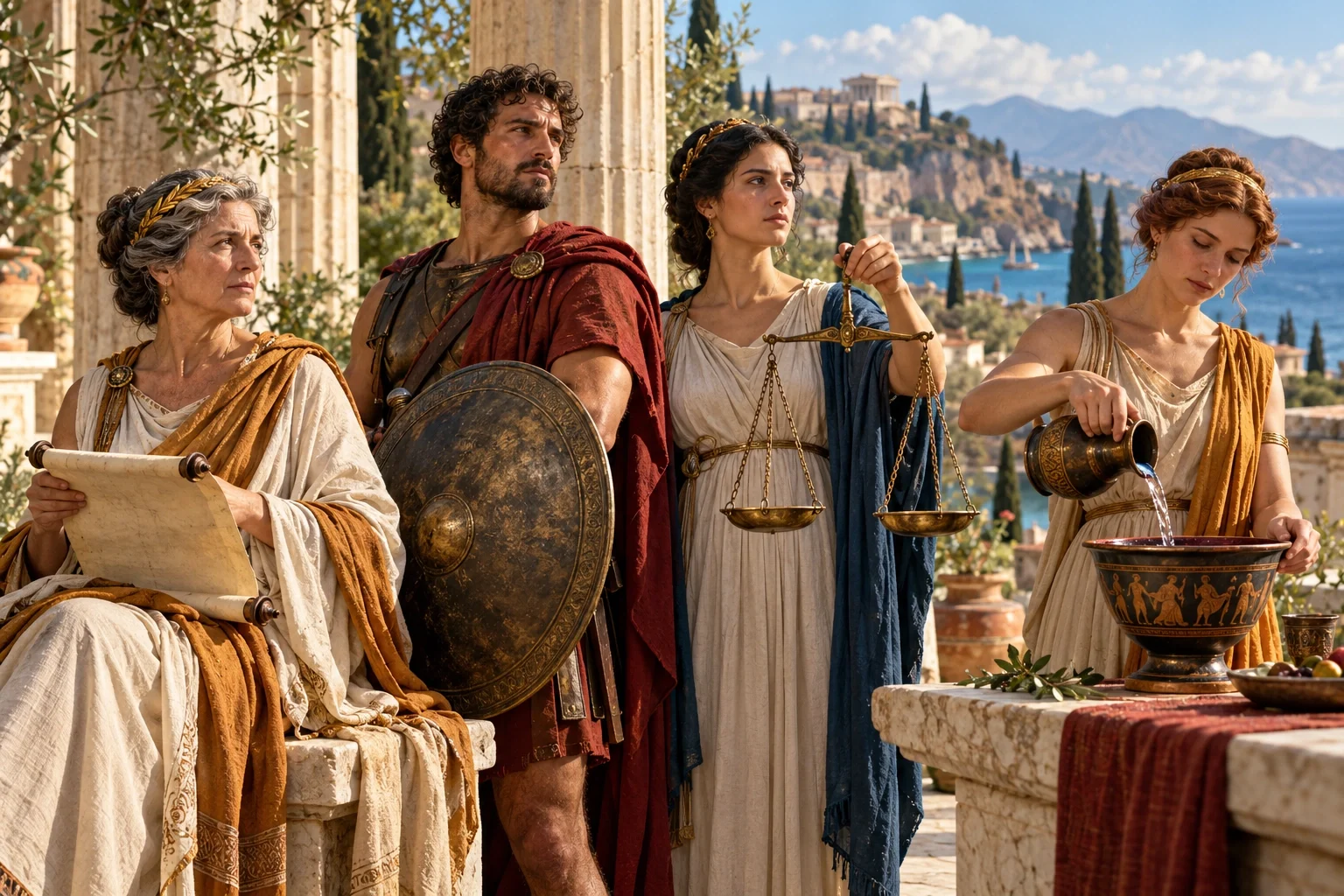
The four Stoic virtues are wisdom, courage, justice and temperance. The Stoics inherited the list from Plato and made it the center of their ethics: virtue, they argued, is the only true good, and everything else, health, wealth and reputation included, is “indifferent” to whether a life is good. Wisdom is knowing what is good, bad and neither. Courage is knowing what to endure and what to fear. Justice is giving others what is due and acting for the common good. Temperance is the right measure in desire and pleasure. The Stoics also held that the virtues are united: you cannot truly have one without the others, because all four are forms of the same knowledge applied to different situations. In daily life they work less as ideals to admire and more as four questions to ask before acting.
Key takeaways
- The four cardinal virtues are wisdom (phronesis or sophia), courage (andreia), justice (dikaiosyne) and temperance (sophrosyne).
- For the Stoics, virtue is the only good and vice the only evil. Everything else is indifferent, though some indifferents are preferred.
- The virtues form a unity: they are aspects of one knowledge of how to live, applied to different areas.
- Each virtue had subdivisions. Under temperance, for example, the Stoics listed good discipline, propriety, modesty and self control.
- In practice, the four virtues work as a checklist: is this wise, is it brave, is it just, is it measured?
Where the list comes from
The four cardinal virtues appear in Plato’s Republic, where they are the virtues of the ideal city and of the well ordered soul. The Stoics took them over and gave them a new foundation. For Plato, the virtues correspond to parts of the soul. For the Stoics, who saw the soul as unified, they are different expressions of a single rational excellence.
Diogenes Laertius, in his life of Zeno, reports the Stoic classification: the primary virtues are wisdom, courage, justice and temperance, and under them come many particular virtues, such as magnanimity, endurance, good judgment and self control. Later writers used the word “cardinal”, from the Latin for hinge, because the other virtues turn on these four.
Why virtue is the only good
This is the most demanding claim in Stoic ethics, and the one most often softened by modern popularizers. The Stoics did not say that virtue is the most important good. They said it is the only one.
Their reasoning goes roughly like this. A good thing, properly speaking, must always benefit whoever has it and can never be used badly. Money can be used to harm. Health can serve cruelty. Intelligence can make a skilled fraudster. Only virtue cannot be misused, because virtue is the knowledge of how to use everything else well. So only virtue is good without qualification.
Everything else, life and death, health and illness, wealth and poverty, fame and obscurity, belongs to the class of indifferents: neither good nor bad in themselves, but material on which virtue works. The Stoics did not pretend these things are equal. Some, like health, are “preferred”, and it is reasonable to pursue them. Others, like illness, are “dispreferred”, and it is reasonable to avoid them. What is not reasonable is to treat them as the measure of a good life, or to pursue them at the cost of acting badly.
This is where the virtues and the dichotomy of control meet. Virtue is entirely up to you. Indifferents are not. That is why the Stoics could say that a good person cannot be harmed in the way that matters, whatever happens to them.
The unity of the virtues
A second claim follows. If each virtue is a form of knowledge about how to live, then they cannot really be separated. Courage without wisdom is recklessness. Justice without temperance can turn into self righteousness. Temperance without courage can become timidity. The Stoics held that someone who truly has one virtue has them all, because they all depend on the same understanding.
This sounds like a technical point, but it has a practical edge. It warns against admiring a single trait in isolation. The brave but unjust person is not brave in the full sense. The disciplined person who uses discipline to dominate others has missed the point. Each virtue needs the others to be what it claims to be.
Wisdom
Wisdom, for the Stoics, is knowledge of what is good, what is bad and what is neither. It is practical before it is theoretical: the ability to see a situation clearly and judge what it calls for. Under wisdom they placed good deliberation, good calculation, quick wit and resourcefulness.
In modern terms, wisdom is the virtue of telling the important from the merely pleasant or alarming. It shows in decisions more than in opinions. More in Stoic wisdom: telling the good from the merely pleasant.
Courage
Courage is knowledge of what is to be endured and what is to be feared, or, as some Stoics put it, of what is terrible, what is not and what is neither. It includes endurance, confidence, high mindedness and industriousness.
Stoic courage is broader than physical bravery. It is the courage to tell an uncomfortable truth, to stand by an unpopular decision, to face illness without collapsing and to act rightly when it costs you. Since the Stoics held that nothing outside virtue is truly bad, courage is partly the result of seeing clearly what there is to fear, which is less than we think. More in courage, the Stoic way.
Justice
Justice is the knowledge of how to give each person what is due. It includes piety, kindness, sociability and fair dealing. For the Stoics, justice rests on the conviction that human beings are a single community, bound together by reason. Marcus Aurelius calls the universe a kind of city, and reminds himself that what is not good for the hive is not good for the bee.
Justice is the virtue modern Stoicism most often forgets, which is strange, because for the ancient Stoics it gave the others their purpose. A person who is wise, brave and self controlled but indifferent to others has turned the philosophy into a private wellness program. More in justice: the virtue Stoicism is accused of forgetting.
Temperance
Temperance, sophrosyne in Greek, is the knowledge of what to choose and what to avoid in matters of desire and pleasure. It includes good discipline, propriety, modesty and self control. It is often translated as moderation, but the Greek word suggests something closer to soundness of mind: a mind not distorted by appetite.
Temperance is the virtue that governs our relation to everything we want: food, drink, money, attention, approval. It is not abstinence, and it is not a rule of always choosing the middle. It is the ability to want things in proportion. More in temperance: the most underrated virtue.
The virtues as four questions
For practical purposes, the four virtues work well as a short checklist before a decision or at the end of a day.
- Wisdom: Am I seeing this clearly, or through fear, desire or habit?
- Courage: Am I avoiding something I should face?
- Justice: Is this fair to everyone affected, including people who are not in the room?
- Temperance: Am I wanting this in proportion, or is the wanting running me?
The questions overlap, which is the point. A decision that passes all four is rarely a bad one.
Virtue and happiness
The Stoics held that virtue is not only necessary for happiness but sufficient: a virtuous person is happy, whatever their circumstances. Few modern readers accept this in its strict form. It seems to deny the obvious fact that pain, poverty and loss make life worse.
A softer version is easier to defend and still valuable. Whatever else a good life needs, it needs character, and character is the part of it that no one can take away. We return to this in happiness without hedonism and in is virtue really the only good?
Frequently asked questions
What are the four Stoic virtues?
Wisdom, courage, justice and temperance. The Stoics inherited the list from Plato and made it the center of their ethics.
Why did the Stoics think virtue is the only good?
Because only virtue always benefits its possessor and cannot be misused. Health, wealth and reputation can all serve bad ends, so the Stoics classed them as indifferent, though some are reasonably preferred.
What is the unity of the virtues?
The Stoic doctrine that the virtues are aspects of one knowledge of how to live, so that a person who truly has one has them all.
Which Stoic virtue is the most important?
The Stoics did not rank them, since they saw them as inseparable. Wisdom is often treated as the root, because the others are forms of knowledge, and justice as the one that gives the others their social purpose.
How can I practice the Stoic virtues?
Use them as questions before a decision or in an evening review: Am I seeing clearly? Am I avoiding something I should face? Is this fair to everyone affected? Am I wanting this in proportion?
Sources
- Diogenes Laertius, Lives of Eminent Philosophers, Book 7 (Zeno), trans. R. D. Hicks, 1925.
- Marcus Aurelius, Meditations, trans. George Long, MIT Internet Classics Archive, accessed October 22, 2026
- Stanford Encyclopedia of Philosophy, Stoicism, accessed October 22, 2026
- Internet Encyclopedia of Philosophy, Stoicism, accessed October 22, 2026