

Short answer
Stoicism is a philosophy founded in Athens around 300 BC by Zeno of Citium and developed over five centuries by Greek and Roman thinkers, among them Chrysippus, Seneca, Epictetus and the emperor Marcus Aurelius. Its central claim is simple to state and hard to live: a good life depends on the quality of our own judgments and choices, not on things outside our control. The Stoics organized this into three habits. Want only what is truly up to you. Do not accept every impression as true until you have examined it. Act with justice and for the common good. The virtues that result, wisdom, courage, justice and temperance, were for them the only real good. Stoicism is not the suppression of emotion, not resignation and not a productivity method, even if it has been sold as all three.
Key takeaways
- Stoicism began with Zeno of Citium in Athens around 300 BC. The name comes from the Stoa Poikile, the painted porch where he taught.
- Its core: what depends on us (our judgments, intentions and actions) matters more than what does not (reputation, wealth, health, outcomes).
- The Stoics divided philosophy into logic, physics and ethics. Epictetus turned the practical side into three disciplines: desire, assent and action.
- The four virtues, wisdom, courage, justice and temperance, are the only true good. Everything else is “indifferent”, though some indifferents are reasonably preferred.
- It is not about feeling nothing. The Stoics wanted to be free of destructive passions, not of feeling.
Where the name comes from
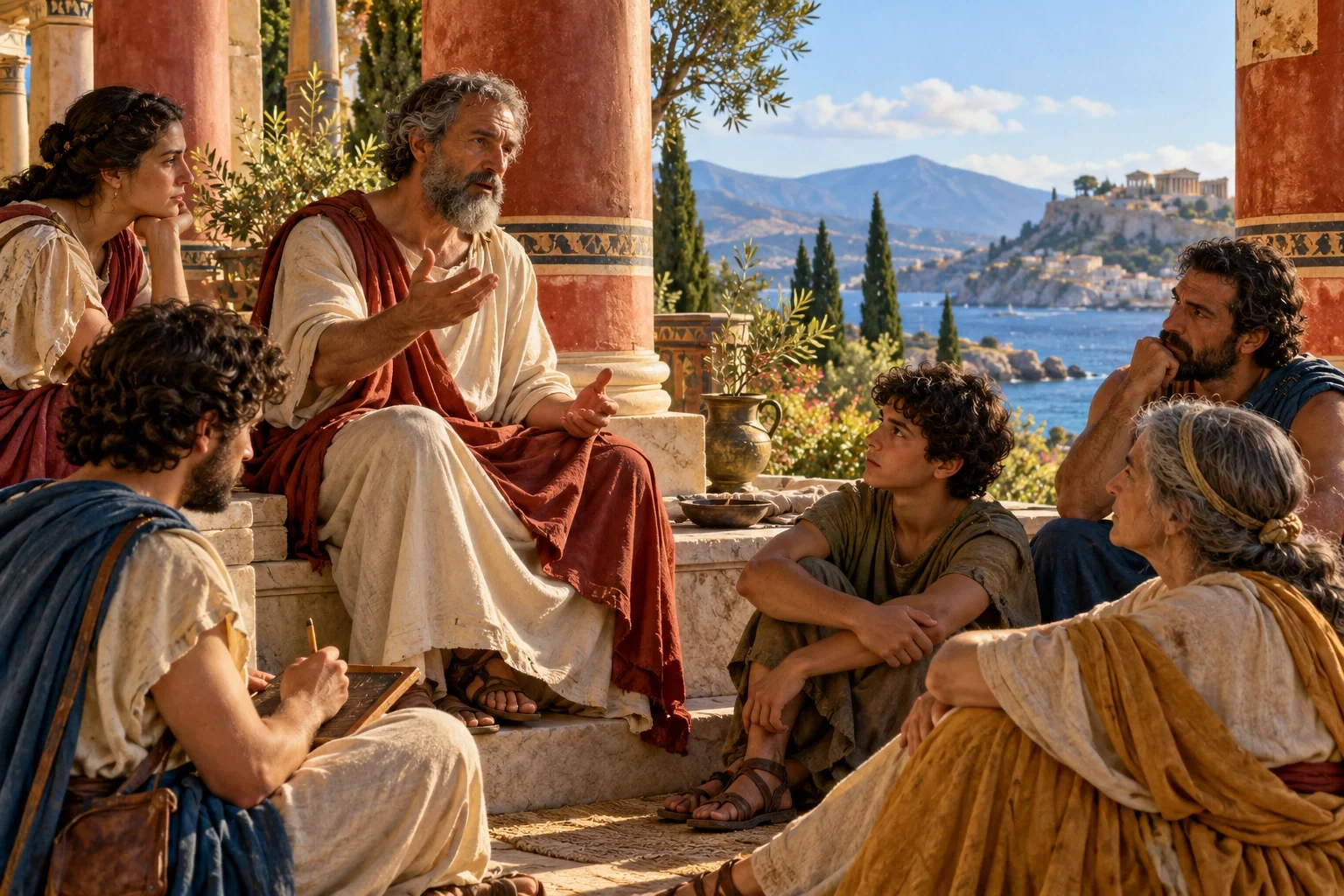
Zeno of Citium arrived in Athens as a merchant, the story goes, after a shipwreck. He studied with several teachers, including the Cynic Crates, and eventually taught in public under the Stoa Poikile, a painted colonnade on the north side of the Agora. His followers were first called Zenonians and later Stoics, the people of the porch. The detail matters more than it seems. Stoicism was born as a philosophy taught in a public place, to anyone who stopped to listen, about how to live among other people. It was never a doctrine for hermits.
After Zeno came Cleanthes and then Chrysippus, who systematized the school so thoroughly that the ancients said that without Chrysippus there would have been no Stoa. Almost all of their writing is lost. What most readers know today comes from the Roman period: the letters and essays of Seneca, the lectures of Epictetus written down by his student Arrian, and the private notebook of Marcus Aurelius that we call the Meditations. Those three men could hardly have been more different. One was a wealthy senator and adviser to Nero, one was born a slave, one ruled the Roman Empire. That variety is part of the argument: the philosophy was meant to work in any position in life.
The central idea: what depends on us
The Enchiridion of Epictetus opens with the sentence that sums up the whole system. In George Long’s translation: “Of things some are in our power, and others are not.” In our power are our opinions, our impulses to act, our desires and aversions, in short our own acts of mind. Not in our power are the body, property, reputation and office, in short everything that is not our own doing.
The point is not that external things do not matter in a practical sense. Your health, your income and other people’s opinion of you affect your life. The point is that they are not, in themselves, what makes a life good or bad. A person can be rich and wretched, praised and corrupt, healthy and cruel. What decides the quality of a life is what you do with whatever you have been given. That is where the Stoics placed all their attention, and it is the reason the philosophy has always appealed to people under pressure: soldiers, prisoners, politicians, people who are ill, people who have lost something.
The dichotomy of control is the name modern readers give to this idea. It is the first of the four topics on this site, because almost everything else depends on it.
The three parts of philosophy
The early Stoics compared philosophy to a living thing. In one image it is an orchard: logic is the wall, physics the trees and ethics the fruit. In another it is an egg: logic is the shell, physics the white, ethics the yolk. The three parts were not separate subjects but one way of seeing.
- Logic included the study of argument and language, but also the theory of knowledge: how we receive impressions of the world and how we decide whether to accept them.
- Physics was the study of nature as a whole. The Stoics saw the world as a single ordered system, governed by reason, in which every event has a cause.
- Ethics was the study of how to live in agreement with that nature, and in particular with our own nature as rational and social beings.
Modern readers often keep the ethics and quietly drop the physics, which included a providential universe and a cyclical cosmology most people no longer accept. That is a reasonable choice, and most contemporary Stoicism makes it. But it is worth knowing that the ethics was built on a picture of the world, and that some of its demands, like accepting what happens, made more sense inside that picture than outside it.
The three disciplines of Epictetus
Epictetus reorganized the practical side of the philosophy into three areas of training, which the French scholar Pierre Hadot later called the three disciplines. They are the most useful map of Stoicism for anyone who wants to practice it rather than study it.
- The discipline of desire. Learn to want only what depends on you, and to accept what does not. This is the dichotomy of control applied to the heart.
- The discipline of assent. Do not accept an impression as true just because it arrives with force. Between what happens and what you conclude about it, there is room to examine. This is the subject of our topic on the gap between stimulus and response.
- The discipline of action. Act on principle, with justice, for the common good, and with a reservation about the outcome. This is the subject of principle over impulse.
The fourth topic, the four stoic virtues, describes the character those three disciplines are meant to build.
Good, bad and indifferent
The most demanding Stoic doctrine is that virtue is the only good and vice the only evil. Everything else, health, wealth, reputation, even life itself, belongs to the category of the “indifferent”. This sounds absurd until you see what it is doing. The Stoics did not say that health and sickness are equal in every respect. They said that neither of them, by itself, makes you a good or bad person, and that both can be used well or badly.
To handle the obvious objection, they divided indifferents into preferred and dispreferred. It is reasonable to prefer health to sickness, enough money to poverty, a good name to disgrace. You may pursue them. What you may not do is treat them as the measure of your life, or pursue them at the cost of acting badly. A Stoic can work hard to earn a living. A Stoic cannot lie to do it.
This is where many popular accounts go wrong. Stoicism does not ask you to stop caring about your health or your family. It asks you to care about them in the right way: to do your part fully and to accept that the result is not entirely yours.
What Stoicism is not
Because the word “stoic” in everyday English means someone who shows no emotion, the philosophy is often mistaken for an ideal of emotional coldness. It is worth being precise about what it is not.
- Not the suppression of feeling. The Stoics distinguished between passions, which they saw as excessive impulses based on false judgments (terror, rage, craving), and natural reactions that happen to everyone, like a start of fear at a sudden noise. They also described good feelings: joy, caution and goodwill. The aim was to feel well, not to feel nothing.
- Not passivity. Accepting that the outcome is not in your hands is not the same as not acting. Marcus Aurelius spent most of his reign on military campaigns and administrative work. Seneca wrote that the wise person engages in public life unless something prevents it.
- Not selfishness. Stoic ethics is social at its root. Human beings are made for cooperation, the Stoics said, like hands or feet. Justice is one of the four virtues, and arguably the one that gives the others their purpose.
- Not a productivity system. Stoic ideas can make you calmer and more focused, and there is nothing wrong with that. But a philosophy whose highest good is character cannot be reduced to a method for getting more done.
- Not a rule book. The Stoics gave principles, examples and exercises, not a list of commandments. Applying them requires judgment, which is exactly what they wanted to train.
Stoicism and its neighbors
Two comparisons come up again and again.
Stoicism vs Epicureanism. The two schools were rivals in Athens and Rome. Epicurus taught that pleasure, understood as the absence of pain in the body and of disturbance in the mind, is the goal of life. He recommended simple living, friendship and withdrawal from politics. The Stoics answered that pleasure is a by-product, not a goal, and that virtue alone is good. In practice the two schools agreed on more than they admitted: both valued simple living, both thought fear of death was based on a mistake, and Seneca quotes Epicurus with approval throughout his letters. The real difference is in what they put at the center: tranquility for the Epicureans, virtue for the Stoics.
Stoicism vs Buddhism. The comparison is natural, since both traditions locate suffering in our own judgments and attachments and both prescribe mental training. The differences are real, though. Buddhism aims at liberation from craving and from the cycle of rebirth, and teaches that the self is not a fixed thing. Stoicism has no doctrine of rebirth, puts reason at the center of human nature and asks you to act fully in the world of roles and duties. One way to put it: Buddhism tends to loosen attachment to the self, Stoicism tends to strengthen the governing part of the self so it can act well.
Neither comparison is a ranking. They help you see what is specific to each tradition.
Why it came back
Stoicism faded with the ancient world, but it never disappeared. Christian writers borrowed from it. Renaissance humanists read Seneca and Epictetus closely. The founders of cognitive behavioral therapy in the twentieth century cited Epictetus directly, in particular his line that people are disturbed not by things but by their opinions about things. In the last two decades the philosophy has had a popular revival, through books, podcasts and online communities.
The revival has been good for the philosophy and bad for it at the same time. Good, because many people have found in it something they needed: a way to stay steady without pretending everything is fine. Bad, because it has also been reduced to quotes on images, to an aesthetic of toughness and to a self-help label. This site tries to take a different route. It takes its cue from the Stoics without treating them as scripture, and tests their answers against modern life and common sense.
How this site is organized
The site has two parts. This first part, What Stoicism Is, covers the theory through four topics:
- The dichotomy of control: what is up to us and what is not.
- The gap between stimulus and response: how judgment works and how to train it.
- Principle over impulse: acting by what you value rather than by what you feel.
- The four stoic virtues: wisdom, courage, justice and temperance.
The second part, Practical Stoicism, applies the ideas to exercises, work, money, relationships, decisions and happiness, and reads modern books through a Stoic lens. Running through both parts is a series of Stoic quotes, interpreted and explained, each one placed back in its context.
Frequently asked questions
What is Stoicism in simple terms?
A philosophy that says a good life depends on your own judgments and actions, not on what happens to you. Focus on what is up to you, examine your impressions before you accept them, and act with justice and good sense.
Who founded Stoicism?
Zeno of Citium, who began teaching in Athens around 300 BC under the Stoa Poikile, the painted porch that gave the school its name.
Who are the most famous Stoics?
The best known today are three Romans whose writings survive: Seneca, Epictetus and Marcus Aurelius. The early Greek Stoics, Zeno, Cleanthes and Chrysippus, were more important for the doctrine, but almost all their writing is lost.
Does Stoicism mean not having emotions?
No. The Stoics wanted freedom from destructive passions based on false judgments, such as rage or panic. They accepted natural first reactions and described positive feelings such as joy and goodwill.
What is the difference between Stoicism and Epicureanism?
Epicureans made pleasure, understood as freedom from pain and anxiety, the goal of life and advised withdrawal from politics. Stoics made virtue the only good and encouraged participation in public life. Both recommended simple living and both rejected the fear of death.
Is Stoicism a religion?
No. It is a philosophy. The ancient Stoics did believe in a rational, providential order in nature, which they sometimes called god, but they had no rituals, scriptures or clergy.
Sources
- Epictetus, The Encheiridion, trans. George Long, in The Discourses of Epictetus; with the Encheiridion and Fragments, Wikisource, accessed October 22, 2026
- Marcus Aurelius, Meditations, trans. George Long, MIT Internet Classics Archive, accessed October 22, 2026
- Stanford Encyclopedia of Philosophy, Stoicism, accessed October 22, 2026
- Internet Encyclopedia of Philosophy, Stoicism, accessed October 22, 2026
- Pierre Hadot, The Inner Citadel: The Meditations of Marcus Aurelius, trans. Michael Chase, Harvard University Press, 1998.
The topics in this guide
01
The Dichotomy of Control
The first line of the Enchiridion, and the idea that holds up the rest of Stoicism. What it says, what it does not say, and how to use it.
02
Between Stimulus and Response
A famous line with an uncertain author, and an idea with a very certain one: the Stoic discipline of assent.
03
Principle Over Impulse
The third discipline: turning judgment into conduct. Not willpower against desire, but action that follows from what you value.
04
The Four Virtues
Four names for one excellence of character, and the only thing the Stoics thought was truly good.